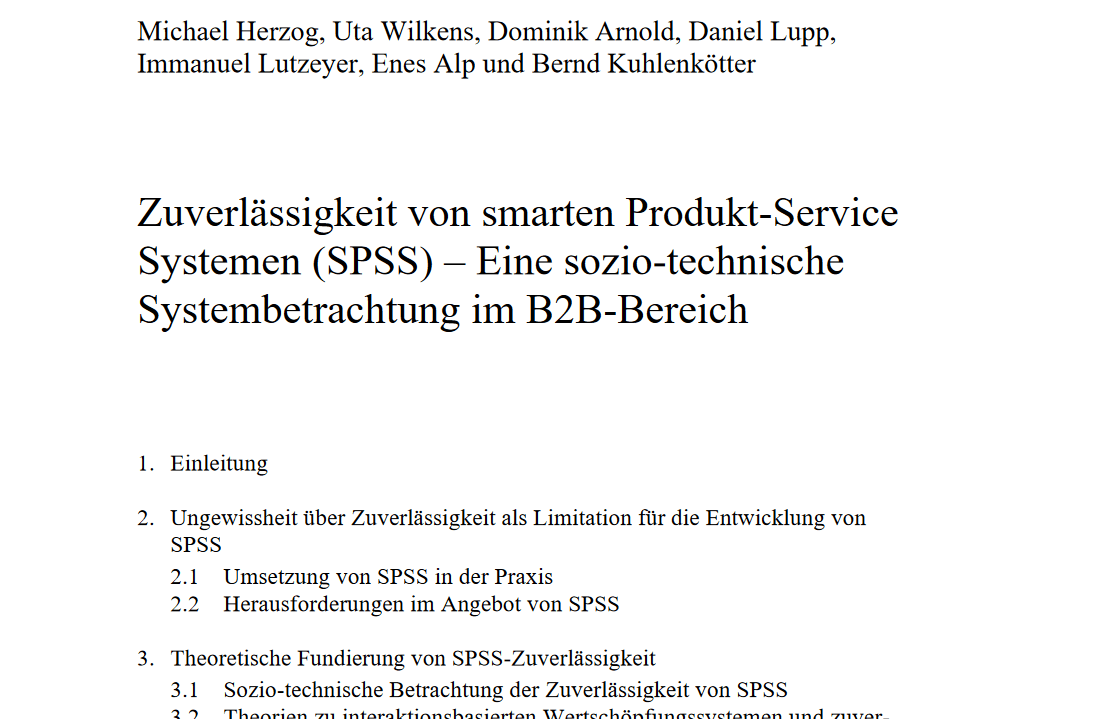

How can the reliability of smart product service systems (SPSS) in the B2B sector be holistically recorded and designed? This question is explored in a recent article by Michael Herzog, Uta Wilkens, Dominik Arnold, Daniel Lupp, Immanuel Lutzeyer, Enes Alp and Bernd Kuhlenkötter, which was recently published in the anthology Digital Analytics in Service Management by Springer Gabler.
The article takes a socio-technical perspective on SPSS and shows which as yet unresolved challenges influence the reliability of such hybrid systems. Based on a comprehensive literature analysis, central problems are identified and illustrated with practical examples. Building on this, the team of authors develops theory-based conceptual starting points for the foundation of SPSS reliability. Among other things, concepts of service-dominant logic, service quality, trust in value creation systems and exchange theories of reliable action are applied. Five central facets of SPSS reliability and corresponding socio-technical indicators for assessing these facets are presented as part of a structured synopsis. An outlook on possible empirical validations rounds off the article.
The publication thus makes an important contribution to the theoretical foundation and practical design of smart service systems in the context of digital transformation. Special thanks go to the co-authors for their productive collaboration and to the editors Prof. Dr. Manfred Bruhn and Prof. Dr. Kerstin.
Citation:
Herzog, M., Wilkens, U., Arnold, D., Lupp, D., Lutzeyer, I., Alp, E., & Kuhlenkötter, B. (2025). Reliability of smart product-service systems (SPSS) – A socio-technical system analysis in the B2B sector. In M. Bruhn & K. Hadwich (Eds.), Digital analytics in service management (pp. 673-707). Forum Service Management. Springer Gabler. https://doi.org/10.1007/978-3-658-48325-8_23